The First in the Deck Series

Our most recent DIY experience through the process.

Out With The Old, In With The New

Gotta love a new beginning, right?

Peppermint Shortage

Just a funny afternoon.

Coffeyville, KS

I loved this experience so much that I had to write about it. Then, through e-mails it spread to Coffeyville itself.

Photo Restoration

I had a lot of fun with this "old school" photo. It turned out too cool to not blog about it.

Kitchen Remodel (part one)

This is the first of a nine-part series documenting the remodel of our 50-year-old kitchen in our 100-year-old home!

Subverting the Norm OR Making Gods of Ourselves?


It's 5:23 AM, Monday, October 18th, 2010. I'm seeing this on the display of my phone wondering why I'm awake when my alarm isn't set to go off for another seven minutes. This has been happening to me a lot lately. I get up and gather the few possessions that I need for the day that I've left all together so as not to have to scramble around the room and risk waking my wife who is probably at minimum partially awake despite my best efforts to the contrary. Downstairs, I put on my work uniform for somewhere around the 220th time. I'm buttoning up the literal, not figurative, blue-collar shirt and I have to let out a little laugh as I come to realize the expansive degree of separation between the profession in which I find myself today and the ones in which I was associating myself with during the weekend prior.

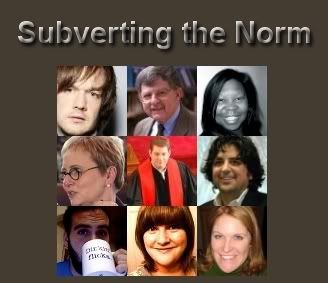
The Friday and Saturday before were two very long days for me as I attended a conference at Drury University entitled "Subverting the Norm: The Emerging Church, Postmodernism, & the Future of Christianity". I didn't count heads or anything, but I figured around 250 people attended the conference for at least part of it, although I doubt that there was ever more than 200 people present at one time. Those in attendance fell almost exclusively into one of two categories: theology scholars or church practitioners. Some were both. I'm sure there were exceptions, but none that I met. Everyone I spoke to either came right out of the gate asking me about my educational background or they first assumed I was a student and then, upon finding out that I wasn't, asked me about my educational background. During one of the sessions that I sat in on hosted by Chris Rodkey titled "Satan in the Suburbs: Ordination as Insubordination", Mr. Rodkey suggested since we were only a small group of about eight that we go around the circle and introduce ourselves. I was second in line and merely said, "Hi, my name is Levi and I'm from right here in Springfield, Missouri." I left it at that despite the continuing eye contact I was receiving from Mr. Rodkey who was, no doubt, encouraging me to share more about myself. But, I just politely held his gaze with a smile to let him know that I had no intention of describing myself any further. After several seconds, he moved on to the next person who without hesitation or pause listed his own currently held titles, the degrees he had and were still studying for, and a couple other qualifications that he must have deemed relevant to the conversation and necessary to be mentioned. The gracefulness and almost sing-song quality in which this information was delivered suggested that these verses of self-qualification had been recited to people many times.

That last observation maybe sounded a bit like I am bothered by being surrounded by academics or that I am in some way demeaning someone for their post-high school education and achieved titles. However, rather than delete the sentences and try again in my defense, let me instead just state that I'm merely attempting to paint a picture as to what sort of people I was attending a conference with while also pointing out that stating one's titles and educational background as a means to introducing yourself was not only done but also encouraged by the hosts. This follows right along the social norm here in the West where it is commonplace to identify oneself with one's occupation. I could write an entire blog about my psychoanalysis on this alone, but instead I'll just say without further explanation that this phenomenon of occupation as a means to self-identity is simply our attempt to feel purpose in our lives. But, as a result, since different occupations have varying degrees of levels of their contribution to society, at least in the eyes of society, people consequently are made to feel that they are only as useful, only as important as their respective occupation relates to the general consensus' view of it's role in contributing to the general welfare of society. In layman's terms, the hosts at this conference advocated, whether purposefully or not, the old phrase 'you are what you do.'

There's entirely too much to go over about what I disagreed with at this conference without writing a book about it. Which, who knows, maybe I will do eventually. But, I will say that of all the names of writers, theologians, scholars, and the like being thrown around that weekend, none did I hear so often than those of Jacques Derrida, Thomas Altizer, and John Caputo (who was one of the keynote speakers at the conference). One name I didn't hear save for a few times was that of Friedrich Nietzsche.

Nietzsche's writings, I will say with much conviction, is the launch point of the entire movement in which the conference was being held. Nietzsche's statement, "God is dead", brought into mainstream media by TIME magazine, ushered in a new theology most commonly referred to as 'Death of God Theology.' There was much talk about this theology throughout the entire conference, so much in fact, that at one point I jokingly wondered if I hadn't stumbled into the wrong conference altogether. At the time, I was unaware of what this theology even was and only had a vague understanding, at best, of what Nietzsche had written about all those years ago.

I still have loads of research to do before I can come to any solid conclusions or theories of my own, however in good scientific form I will throw out my hypothesis on the table: Postmodernistic thought was born not out of a study of the Word of God and documented history, but rather came out of a self-negating philosophy that sought self-justification. The emergent church (and most 'emerging' churches, as well) are simply the ecclesiological practices of this theology which may be better defined as atheology. To put it simply, the only thing that I can see that separates these people from atheists is that they claim that there is a God, but they completely and radically redefine what God is into something unknowable. And, thus, create their own God based out of their own desires and cultural standpoint.

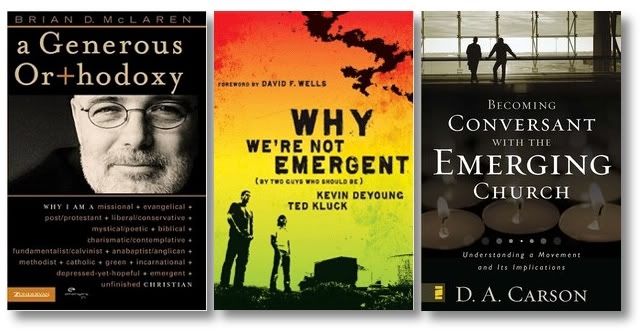
Like I said, I won't go into why I believe this hypothesis to be true because I haven't done all the intended research yet and right now I'm only basing this on my own observations. But, for good measure I have opened the door here to any critics (as well as anyone else) to contribute to the ongoing conversation that I am having here. I have no "formal education" that gives me some status, official knowledge level, or title. I just read and research those subjects that I feel God gives me a passion for. So far, in direct relevance to the subject at hand, I have attended the conference that I spoke of here in this blog, a book study on A Generous Orthodoxy by Brian McLaren, and have read the following books:

  • A Generous Orthodoxy by Brian McLaren
  • Why We're Not Emergent (By Two Guys Who Should Be) by Kevin DeYoung & Ted Kluck
  • Becoming Conversant With The Emerging Church by D.A. Carson

PC vs Mac

The title of this blog, when looking at it in print, brings the game Pac-Man to mind. Not that PacMAn has anything to do with this blog. I'm just saying.

I have been a PC user most of my life. My earliest memory of using a computer was in second grade at Eugene Field Elementary, here in Springfield. The year was 1986. I learned the ins and outs of DOS and then LogoWriter. The years went by but my computer experience never strayed from the PC.

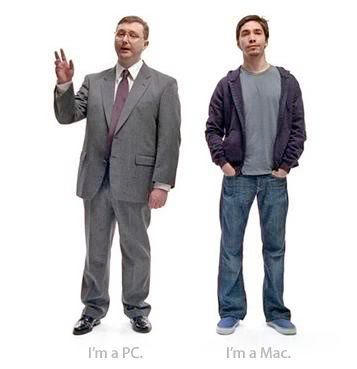
Then came a day many more years down the road when Apple started making fun of PCs in their advertisements making the assumption that Macs were not only more advanced but also more stylish, more laid back, cooler, more popular, etc. While I did find the ads humorous mostly, I also resented Apple for their conceited campaign, much like you would if a chess geek was heckling one of your math club buddies.

Fast forward to a few weeks ago. Due to God's good graces, I was able to purchase a Mac off Craigslist from a guy who had bought it new many moons ago. Inside all the well-kept boxes & packaging I found the original invoice from the store with the guy's name on it. He had sold me the entire setup for $30 even though he had paid $3,400 for it! Eeeek!

It's really pretty, aesthetically speaking. It's easy to install software on, and I was really impressed with the simplicity of installing hardware. I installed 4 sticks of RAM, a PCI card that added USB 2.0, and a bluetooth adapter. Of course, the RAM doesn't need a driver, but the latter two would have needed drivers to function properly on a PC. But, when I booted up the Mac it was already using them without a hitch, no drivers necessary.

So, I can see why Mac users like their machines. I don't have enough experience yet with the running of programs to be able to say anything on the subject except that I hear that programs work like they're supposed to without the issues that sometimes plague PCs.

However, so far, my official position takes sides with PCs. The biggest reason is price. Last week, my motherboard got fried mysteriously in my best PC. It was about three years old and had been part of a barebones kit that I bought for somewhere around $130. The kit included the processor, motherboard, case, fan, and power supply. I found a new motherboard on TigerDirect that will allow me to reuse everything and just swap out the old for the new. I won't go into detail, but it's way better than the one that fried and it's only $50.

You just can't do that with a Mac. Parts are very expensive. For example, a replacement motherboard for a G5 Mac that would be similar, yet not quite equivalent, to my computer would cost a whopping $430.

But price isn't the only reason. There are tons more programs available, it seems, for a PC that aren't even available in a Mac compatible format. Mac users may argue with me on this point citing the PC emulator that allows a Mac to run PC programs. But, what does that say for Macs that they would want to emulate a PC?

I will concede that Macs are better quality both in their hardware and software than your average PC. I've had my fair share of issues with PCs. But to be fair, those problems were largely due to my inexperience and naivete. I've learned much over the years, some the hard way. For example, I bought a barebones kit from TigerDirect once that sounded great and was nice and cheap. I had been using a Pentium II 350 Mhz Gateway up to that point, but I was ready, or so I thought, to get into editing more than just the occasional photo. I wanted to edit home movies. So, I got the computer up and running, but it crashed the first time when ripping a CD. It did it again later doing the same thing. I realized that I had some bad RAM and it wasn't dumping the memory properly so it would just get full and then >poof<. New RAM solved the problem. Later, though, I had the same issue when rendering video. I bought some more RAM, at that point thinking that it would solve it, but it didn't. I got really frustrated because this new computer was an AMD 2 Ghz processor and I had 2 GB of RAM. This thing should be able to fly! Upon searching out forums on the subject, I found my answer: Front Side Bus. The FSB was only 100 Mhz. The guy on the forum explained it by saying, "You have an awesome processor that's like 20 semi trucks driving side by side on a 20-lane highway, but to get to the RAM and back the 20-lane highway bottlenecks at your front side bus down to a 1-lane bridge."

I didn't know what front side bus was. TigerDirect had plainly made it known on their site that it was only 100 Mhz, I just didn't know what that meant at the time. You can't just replace your front side bus, either. It's built into your motherboard. All you can do is get a new motherboard, which I did. But, that was the one that just fried. Oh well, it was a great motherboard for 3 years. And I have a better one coming.

Through my mistakes and searching, I now have an amazing collection of programs that work flawlessly. I have hardware that runs all those programs super fast and simultaneously. I have all this and I still haven't spent as much combined in the last 11 years of owning computers as I would have spent on one Mac that would have been long ago obsolete.

Negativity Scene


Would you agree that you are unhappy? Would the word 'content' ever come to mind when asked to describe yourself? The reason that I ask is because I see a lot of negativity where I work. It's pretty rampant in most workplaces really. But, the workplace isn't the only place, by any means. It just stands out in my own little corner of the world.

It seems as if almost everywhere I go, I see and hear people complaining about anything and everything. It's their job, or spouse, or kids, or family, or bills, or commitments, or school, or one of a thousand other things. What do you talk about with people? What do you focus on?

It's funny. Have you ever noticed that when you're driving and you look off to one side or the other that you subconsciously turn the wheel ever so slightly in the same direction? It's a matter of focus. Our focus leads our direction. This point of truth can be illustrated in countless ways, really. Having been through extensive leadership training throughout the years I also learned that people are many times more likely to accomplish the goals that they set for themselves rather than the ones set for them.

The Bible tells the story of Peter walking out onto the water going out to Jesus (Matthew 14:22-33). Peter was able to walk on water just like Jesus until he took his focus off of Jesus and placed it on the storm and the waves. The passage specifically says that he saw the storm and was afraid. He put his focus on something negative and began to fall into the water in which he was focusing. Like Peter, we live out the reality of what we spend our time focusing on. In other words, we reach the goals that we set for ourselves.

If you think about and talk to others about all the things that you struggle with, you will always struggle with whatever you do. You will find a struggle regardless of the situation. Also, if you focus on your sickness, you'll eventually be perpetually sick. Every ache will be exaggerated into some pain that you will self-diagnose to be the worst possible ailment. Or, if you feel like somebody did you wrong over something and you spend your time focusing your thoughts and feelings towards it you will eventually start to feel victimized over other situations. Next thing you know, you're living life as a victim. You've decided it.

It's ironic, I suppose, to realize that these things happen because you are successful. You focused on something and you obtained it. You set some goals and you successfully hit your targets. Unfortunately, you were looking at negative targets.

I speak for myself, too, here. I'm not immune to losing sight of what I should be focused on. Far from it, really. But, we need to realize the destructive and constructive power of our focus if we intend to change how we think. Every time we start to think about something that's depressing, vengeful, hateful, worrisome, etc. we need to recognize it for what it is: negative thoughts that lead to negative outcomes. And, then we need to replace those thoughts with positive thinking, admirable goals, good memories, etc. Philippians 4:8 says, "Finally, brothers, whatever is true, whatever is noble, whatever is right, whatever is pure, whatever is lovely, whatever is admirable--if anything is excellent or praiseworthy--think about such things."

Thanking God for being able to do whatever you are doing at the moment does wonders for your feelings about your current task. Sometimes we just need to slow ourselves down, slow our thinking down, stop thinking about all the things that we could be doing and just be thankful for what you are doing. Be thankful for the health you do have even if it's not perfect. This sounds cheesy but, you cannot change the past nor obtain it again. Likewise, the future will always be outside your grasp. We own nothing in this world, not even time. We cannot make any more of it and we cannot retain any of it. It's God's gift to us what little time we are allowed to experience. That is why it is called 'the present'. We could all stand to be a lot more grateful, don't you think?

Mahmoud Ahmadinejad Makes Good Point


On Thursday, Ahmadinejad, President of Iran, gave a speech at the UN. Amongst his many topics, was the attacks on the United States on September 11th, 2001. Reportedly, a bunch of government officials walked out during the speech including the US Representatives. So, I see that many didn't agree with him, nor did they want to hear anymore on that subject or any other. President Obama has already given a statement, condemning Ahmadinejad for his "inexcusable" statements.

Despite what people may think of me for saying this, I have to agree with him about what he said concerning 9/11. He listed three different theories of who was responsible for the attacks. In a nutshell they are: some foreign terrorists did it (our government's official version), our own government did it, and lastly that foreign terrorists did it but our government saw them coming and took advantage of the situation.

The UN Representatives for the United States walked out during the second theory. Many other country's representatives left, as well. One reporter called what Ahmadinejad said "vile conspiracy theories" and, of course, Obama was acting very offended as if Ahmadinejad was insinuating that Obama himself had orchestrated the whole thing.

But, everyone is missing the point here due to our preconceptions of the man giving the speech. I don't agree with most of what Ahmadinejad said, but the things he said concerning 9/11 were right on. He only called a spade a spade and mentioned that there are multiple accounts for what happened that day, evidence that points to people other than the officially accused, and questions that have not been answered nor had honest attempts of aptly answering them by our government. He further suggests that the UN put together a fact finding team, to answer these questions.

If you think about it, he's properly using a democratic process. The US government has had 9 years to find and provide answers to the obvious 'who', 'why', and 'how' questions. Instead, it only took them hours to point a finger. Despite the ridiculous amount of new evidence that would implicate more involvement from others, this finger has never stopped pointing at the initial suspects and has turned a deaf ear to any suggestion that the event had co-conspirators other than those already named.

This deaf ear, continues today with the walkout of our government at the mere mention of theories that have been sparked, not by Ahmadinejad, but by unanswered questions and intentional government cover-ups.

Ahmadinejad's reason for bringing up 9/11 was to point out that the United States government's leading of the UN in bringing punishment to Iran for their "lack of transparency" surrounding their nuclear program couldn't be more ironic. It might be difficult to find a better example of the pot calling the kettle black.

How can I relate the two, you might ask? The United States used 9/11 as a springboard to invade two countries, and completely overthrow the government of one of them. Several thousand people did die on 9/11, but several hundred thousand have died in the United States' mission to avenge the supposed responsible parties. The United States' military force driven by a government that needs no solid evidence to choose a target is, in and of itself, a weapon of mass destruction. However, the US government feels no need to further investigate nor answer any questions. On the contrary, they get upset and leave just by the mere mention of the subject. Which only leaves us to believe that they're avoiding discussion on the subject because there is something to hide.

Volition


Around a week ago, I followed a link posted by a friend on facebook to a short film. Somewhere it had said, "preview the movie." So, I thought it would be a normal movie preview and be a couple of minutes long. It turned out to be 15 minutes long. It wasn't a movie preview. It was a short film. It's called Volition.

It was very powerful. I recommend that everyone watch it. I was so moved by it, in fact, that I didn't hesitate in purchasing a copy.

Later that evening, I received a personal e-mail from a couple thanking me for purchasing the movie and supporting their cause. The movie arrived at the end of last week and we've already watched it again. The movie was professionally packaged complete with artwork. The packaging to ship the movie to me, on the other hand, was a simple bubble mailer that had both my and the return addresses hand-written. It's neat that we bought a movie straight from the people who made it rather than some large corporation that only sold it for another corporation.

On the DVD were some bonus features that included the original promotional video advertising a video contest. Apparently, Volition was one of the finalists in the 2008 contest. The prizes consisted of dollar amounts to go out to the finalists to go towards their next film. It was really awesome. Also in the bonus features were the 10 movie trailers for the 10 finalists of 2008.

What an awesome concept! It's called the Doorpost Film Project. Their website can be found here. But, most importantly, the short film ,Volition, can be be viewed for free right here. Watch it!

9/11 Conspiracy?


After writing the last blog, Jodi and I watched the movie World Trade Center starring Nicholas Cage. It was, of course, a sad movie. Even more so since we remember watching these events as they unfolded on our TV screens nine years ago.

Remembering all that took place that day and the days that immediately followed, one finds oneself in the eye of a storm of emotions, thoughts, and unanswered questions. 'Who', 'why', and 'how' being the ones in the forefront.

Not long after the event, we were given answers to those questions. A foreign religious extremist group of radicals was the 'who.' Their extreme religious beliefs were the 'why.' And, a simple story of terrorists among us exploiting a weakness was the 'how.' So, mystery solved, right? Isn't that what really happened? I know that I bought it without question. At least in the first few weeks, anyway. However, as the weeks turned into months, all kinds of questions were raised. One being the locked up secrecy in which they hauled off, quarantined, and then sold for scrap the wreckage of the World Trade Center buildings. What purpose could secrecy about the evidence serve? The world saw the buildings come down. We were all given a fairly good explanation as to why they came down. Why would the government go to the extra effort of hiding the material from everyone? Unless, of course, leaving the material out for anyone to see might reveal something they don't want us to know. Hmm...

Other questions started arising that led me to start searching for answers on the Internet. It didn't take long to find several web pages and YouTube videos that not only were asking similar questions but were also presenting evidence that I had either not yet been made aware of or I had not thoughtfully considered.

My initial thoughts were of doubt. Less doubt about what I had been led to believe along with the rest of America, but more towards what these "conspiracy theorists" were trying to get me to think. No one could have done this. No one could be that evil. No one could have kept the truth quiet and hidden. It's too complex to have been pulled off without getting caught.

But, am I right? Why would I believe that a bunch of radical Muslim extremists living in the mountains of Afghanistan are that cunning, evil, and capable? Because it's easier to believe that some Muslims are that evil? Because to believe that I've been deceived would be a blow to my intellect? My pride? Because, I think that everything is hunky-dory here in the 50 states? Because the news said so? What, exactly?

A great documentary to watch on this subject is called Loose Change. At the end of this very well put together, informative, and unfortunately appalling film the narrator made a statement that really struck me. He said, "You will either have an emotional response to this information or a logical one."

What do you think? Would you be in support of a criminal investigation over the disaster? Would you agree that there is, at minimum, enough evidence and motive to implicate others' involvement so much that a new investigation would seem called for?

Where Were You?


It was Tuesday. I was 22 years old. I was taking a week off of work using "vacation" hours that I had just acquired the previous Friday, the second anniversary of my hire date at Springfield Remanufacturing. I hadn't gone anywhere. An actual vacation, as people define them here in the U.S., wasn't in the budget for me, but I was thoroughly enjoying my time off of work just hanging around the house with Jacob, then only 19 months old.

We left our home, just out of town, around 2:00 in the afternoon to get a few things at Walmart. Along the way, I drove past two gas station both of which had lines of cars stretching out into the streets. I found it odd, for sure, but didn't think too much of it until after I left a hectic Walmart and saw the same lines at other gas stations, as well.

I thought that maybe I should find out what was going on. I switched the car stereo from CD to radio and heard a lot of talk. I only picked up clues, but couldn't figure out exactly what they were talking about. I switched the station twice to find the same talk again and again. The stations were broadcasting the same thing. I heard, "war", "attack on American soil", and "death toll well into the thousands."

When I got home, I scrambled to find the TV antenna that was still packed away despite having lived at the house for over three months. I've never been much of a TV watcher. After hooking up the antenna, I sat and watched the footage for hours.

Alan Jackson wrote a song less than two months after the disaster. That song asked a simple question that has an answer almost everyone in the United States remembers very clearly: "Where were you?" So, where were you when you got the news?

Twitter Delicious Facebook Digg Stumbleupon Favorites More