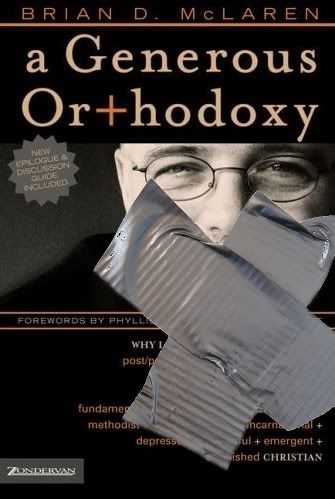
A Generous Orthodoxy’s Lesson on Intellectual Dishonesty
By Levi Felton
To begin, allow me to point out that this is not a book review like you may be used to reading them, but more closely described as a paper on intellectually dishonest arguments. I am using the book a Generous Orthodoxy by Brian McLaren as my sole example because I have yet to read a book that has had as many intellectually dishonest arguments within its pages as it has. If you are looking for a book review, as one would more commonly be written, a quick search of the internet will provide several. If, however, you are looking for a review of sorts from a different perspective or a unique angle, look no further than below.
What is an intellectually dishonest argument? This may be better answered by asking what the opposite is. An intellectually honest argument is one where a person reveals errors or omissions in their opponent’s facts and/or logic. All other arguments fall into the category of intellectually dishonest for they attempt to prove the opponent wrong by attacking something other than the facts or logic of the argument the opponent has made.
The list of intellectually dishonest arguments that you will find here is not complete and in no particular order. There are plenty more being used all over the world even as you are reading this very sentence. I have two goals to accomplish with this paper. The first is to discredit Brian McLaren’s book a Generous Orthodoxy. The second is to encourage others to learn the dishonest tactics of debate. When you learn these tactics and get yourself very acquainted with them, you’ll find that people use them more than you could have ever imagined and it will make you a better debater. Also, you will catch yourself from formulating your own arguments in dishonest ways and save yourself some embarrassment from getting caught. Let’s begin.
Note: I have (or had depending on when you are reading this) the paperback copy, so if you have the book and are looking up pages I reference and you cannot find what I have quoted then it may be due to a separate printing. I do know for a fact that the hard cover edition does have the pages numbered differently from the paperback. Let us hope that there will not be more than one edition of the paperback printed to save further page number confusion, amongst other reasons.
1. Argument from Age (Wisdom of the Ancients)
This is when a very old (or very young) argument is supposedly superior because of its age. The market will use phrases like, “Old Fashioned Biscuits” and “New and Improved.” McLaren uses this tactic several times but in the opposite form. He argues that the theology the Christian church has held as truth for so long is no longer valid in this post-modern society. Another way that he uses this form of argument is when he states that he’s “been around long enough and involved deeply enough” (pg. 25). He does this again when he says that he “learned the hard way” and that it’s his “most valuable credential.” (pg. 22)
2. Poisoning the Wells
This intellectually dishonest argument is when a person discredits the sources used by their opponent. I cannot use just one or two page numbers here. Ultimately, the premise of the entire book is that nearly everything Christians have learned needs to be unlearned. All sources are, in McLaren’s eyes, already poisoned and he uses name-calling, generalizations, assumptions, and stereotypes to paint this picture. One thing that the reader will notice a lot is the use of the ‘post’ prefix (i.e. post-Protestant, post-Liberal, post-Conservative, post-modern, etc.). He attempts to redefine religious terms after unabashedly attacking them as to demonstrate that all people feel the same way about them and therefore they need redefining. This new definition categorizes people as “post” which means ‘after’ even though he tries to make it sound better by stating it means ‘comes from’. This forces the reader into believing that he/she cannot be associated with one of these old terms and still be following Christ by McLaren’s standards.
3. Confusing Correlation with Causation
Just because an event takes place near the time another event takes place does not mean that one caused the other, yet some people will suggest this is true in their arguments. McLaren uses it when he describes his experiences with the conservative Protestant church and the Pentecostal church (pg. 51-59). McLaren’s experiences are written not like his own personal experiences but rather like it’s true of all people who go to any church under these banners. He assumes that because his own correlation with these church organizations led to a certain experience that it was the organization itself that caused it and that it would be and has been true of everyone else affiliated with it.
4. Reifying
Reifying is when an abstract thing is talked about as if it were concrete. McLaren overstates the seven Jesuses quite purposefully so that they appear to be pieces to a larger puzzle; wrong to be by themselves and thinking that “they are it”; right if unified with the whole. This is a complete fabrication worded in such a way to work around McLaren’s views and agenda.
5. Needling
This is when someone attempts to make the other person angry without trying to address the argument at hand. McLaren does this many times but specifically on page 183 when he asserts that the Bible is to equip God’s people to do good works, not to have the answers. So, anyone who feels that the Bible does have answers to life’s questions is left to feel foolish and like they are not following Jesus properly. He doesn’t attempt to show how or why answers cannot be found nor does he list any scripture that backs this different view. McLaren even goes as far to link (pg 177) the belief of having answers in the Bible with “moderately-educated people.”
Near the beginning of the book (pg 40) McLaren warns the reader that he is unfair. He states, “I am consistently over-sympathetic to Roman Catholics, Eastern Orthodox, even dreaded liberals, while I keep elbowing my conservative brethren in the ribs in a most annoying…way.” This is the definition of needling.
6. Straw Man (Fallacy of Extension)
A straw man argument is one where someone, rather than attack their opponent’s argument, sets up a similar but different “example” of their opponent’s argument and then attacks it instead, leaving the original argument virtually unscathed. McLaren tells a parable (pg 155-158) to the reader in Chapter 8. In the story one group splits into two when a difficulty arises and both groups take different paths but both seem to be destined to fail in their survival. After the parable he likens the two groups to conservatives and liberals and states that in order for survival they are both going to have to change, etc. The parable should have began, “Reader, I would like to introduce you to this straw man.”
7. Argument from Adverse Consequences (Appeal to Fear, Scare Tactics)
McLaren contends that the Old Testament is simply not God’s word to people in our time. It, instead, was “God’s word to people back then.” He recounts many examples of violent acts and states that they mis-read the Old Testament. He commends a few well-known peaceful people saying that they have it right. In the end, he contends that there is nothing to learn from the Old Testament except what not to do. This compounds McLaren’s belief that works are what it means to follow Jesus. (This point is solidified by Gandhi being used as an example of someone who followed the way of Christ) The reader is left with a feeling that any belief that the Bible is God’s word to our generation can and will eventually lead to ethnic cleansing being justified. (pg 189)
8. Excluded Middle (False Dichotomy, Faulty Dilemma, Bifurcation)
This is when someone falsely makes a position out to seem like there are only two options to choose from. For example, an old Donald Duck cartoon was so filled with World War 2 propaganda that it taught the children who watched it that either you gave your money to pay your taxes and were patriotic and had the approval of the “Uncle Sam” character (ironically played by Scrooge McDuck) or you spent your money unwisely which made you a Nazi supporter. McLaren (pg 183) makes it appear that either the reader accept that the purpose of scripture is to equip people to do good works or the reader will end up out of God’s will for themselves and the world. There is no middle presented. The truth, though, is that neither is correct.
9. Special Pleading (Stacking the Deck)
McLaren only uses those biblical excerpts that support his liberal wants and desires. This is done to the extent that he not only ignores the Bible verses and stories that teach otherwise, but doubts their validity or even attempts to prove them wrong (sometimes just coming out claiming the possibility of their fallacy).
10. Argument by Question
This is probably the most widely used tactic that McLaren uses. The very nature of a Generous Orthodoxy is that no one is wrong as long as he/she is generous in a liberal/social context. This means that anyone who claims Generous Orthodoxy cannot answer divisive questions. This does not, however, stop McLaren from asking them. For example: (pg 108) McLaren makes what may be his most pointed and concentrated attack in the book. He poses in a barrage of questions that personal salvation leads to terrible outcomes in the way that most churches use it. Question after question is asked but no statement is made. There is great safety in using questions to attempt to make a point. First, there seems to be virtually no accountability to the one posing them after all he/she didn’t lead people astray by telling them something incorrect; they were just asking questions. Second, you cannot be proven wrong if you say nothing. Let us not forget that it was the serpent in the Garden of Eden that led man to sin by questioning first what Adam and Eve believed. While, I realize this seems to be taking it a little too far, in comparing the tactics used by Brian McLaren and Satan, my point is not to liken the two but rather to demonstrate the use of dishonesty in the form of questions and its obvious negative effects on those who are subjected to it.
11. Argument by Rhetorical Question (Loaded Question)
A rhetorical question is one where it is asked but in such a way that the one answering is led to answer a certain way. This is a very popular form of intellectual dishonesty. A courtroom would call it, “leading the witness.” McLaren uses it (pg 108) here as if he is intentionally teaching the reader how to use only rhetorical questions to make an argument. Every question is loaded and leads like a leash and collar. The reader will answer these questions in their head just as McLaren designed them to be answered. Using these answers, then placed in the reader’s minds, he structures latter questions to make it appear that all these answers have only one conclusion: his intended target.
12. Genetic Fallacy (Fallacy of Origins, Fallacy of Virtue)
This fallacious argument is one rarely spoken but rather implied. The idea is that things or people from that social class, or origin, have virtue or lack virtue. Therefore the actual details of the argument can be overlooked since correctness can be decided without any need to listen, study, or think. McLaren traveled from one denomination to the next and the readers are led to believe that he spent a significant amount of time with each of them and that he was there long enough to be considered one of them. Few people skip through denominations like McLaren has and so, to the reader, he comes off as having truly been a part of all these different views. By being an accepted part of them he establishes himself as being correct in all he says about them. Readers will tend not to question or doubt Catholics about what they say about Catholicism. Quite the opposite, rather, readers will assume that they are experts on the subject. Sometimes a person will directly make this argument by saying something like, “Take it from me. I’m a …”
13. Argument by Personal Charm
This is a tactic used to get your audience to cut you slack. Charm may create trust, or the desire to “join the winning team”, or the desire to please the speaker. McLaren appears to be a charming guy through his writing style. He may appear to be modest. Many will believe that he is helping along some very charming goals including loving and accepting everyone for who they are, working towards a peaceful society, and the great financial equalizer commonly referred to as socialism. McLaren illustrates throughout the book how all the modernistic ways of belief and doing things are going to become extinct in this new “post-modernistic world.” He suggests that we must all change our ways of thinking to a Generous Orthodoxy to survive and in that process we will all be better for it, as will the world. These “join the winning team” tactics can be seen on (pg 155-158) in a parable he tells. Another example is (pg 183) when he lays out two polarizations with a clear “winner,” but the “loser” is “losing” because, according to McLaren, how they view the Bible is wrong and ungodly.
14. Appeal to Pity (Appeal to Sympathy, The Galileo Argument)
Some authors want their readers to know that they are suffering for their beliefs. They’ll tell how they cannot get a fair hearing and that if only people would listen to them that they would see that their seemingly radical beliefs are actually right. In McLaren’s book there is a chapter that comes after the two forewords and the introduction, but before chapter one. It is called Chapter Zero – A Generous Refund. It’s a warning to the reader. Nine times (I counted) he suggests to the reader that he/she should seek to return the book where they purchased it and that hopefully it isn’t too late to receive a refund. These warnings come off, and I believe they were meant to, as more than a dare than a sincere warning. These are aimed at the rebel who is ripe for the picking. He even says at the end of the chapter that he is primarily writing to the Christians who are about to leave the church for disagreeing with the doctrinal distinctives and to the spiritual seekers who are attracted to Jesus but don’t feel that they fit in any church for their differing beliefs. The entire chapter describes how McLaren will be the subject of scrutiny and will have everything that he is about questioned. He states that people will say he needs professional counseling, he’s naïve, and that he’s only trying to validate non-conservative positions. He seems confident rather than pitiful, though. One can easily see where this attitude about it further appeals to the rebel. His ultimate appeal to pity/sympathy while also appealing to the rebel is in the statement he makes about how the reader may not even want to be seen with the book for risk of “guilt by association”. (pg 42) He exaggerates his own need for protection against those who disagree with him by stating that he plans to change his name and join a witness protection program.
15. Stolen Concept
This dishonest argument is when you use the very thing that you are trying to disprove. It’s arguing in circles no less than when dogs chase their tails. McLaren uses the Bible and claims to be biblical, but also states simultaneously that it isn’t correct about what it says. His view of how the books were written breeds doubt about all of it. He says that the books were written by men and that as such they are full of bias, the author’s personality, and heavily influenced by societal structures at the time of their writing. He even goes as far to point out that some people don’t even believe that the witness accounts of Jesus were true, but that they were works of fiction to inspire. He then applauds these people’s belief and actions (pg 67-68). For an easy read on a more in-depth study on the reliability of the Bible, I suggest Lee Strobel's
The Case for Christ.
16. Argument from False Authority
The opposite, argument from authority, is to claim that the arguer is an expert in the area being argued. In contrast, an argument from false authority states that the arguer is not an expert in the area being argued and therefore you should trust him. It’s strange, I know, but McLaren uses it in chapter zero (pg 38) when he mentions that he is neither a trained theologian nor a legitimate pastor. He instead is an English major who says he is a “confessed amateur.” He then attempts to glorify this by saying, “you may define amateur as ‘one who works for love not money.’” As if professionals aren’t as qualified since they are only doing it for a paycheck, McLaren suggests here with this statement that his heart is more in it than they. Could it not also be suggested that professional’s hearts are in it more since they suffered through all the grueling work to get to a place where they know what they know?
17. Pious Fraud
This sort of fraud is one that is meant to accomplish some good end, on the theory that the end justifies the means. In chapter 10, McLaren gives the reader a diagram attempting to illustrate how the world has been gradually getting less and less violent. Maybe only in America can a reader see this and not immediately wonder what rock McLaren’s been living under. The ethnic cleansing in Sudan, the constant struggle between the Israelis and the Palestinians, the wars in Iraq and Afghanistan, the almost daily suicide bombings to which we’ve grown accustomed, the terrorist attacks, the growing tension and nuclear threats between North Korea and the United States, and the epidemic of sexual slavery all point to a very violent world of clashing empires. This is exactly how McLaren describes the distant past where his diagram begins. He also mentions (pg 69) how we are getting closer to “God’s will being done on Earth which includes the extinction of war.” Later (pg 187) he proposes that God wants a nonviolent and kind humanity. While this may be true, a Generous Orthodoxy’s assumption is a complete transfer of priority. These statements are to set up the fraud that we are moving towards peace on Earth through our own efforts and that it is in this way that God wants it done. While the end, if believed, may be a good one, socially speaking, it still does not justify the means. This aside, it is rather opposite of what the end times sound like coming from Jesus’ own mouth. (Matthew 24:4)
18. Inconsistency
This is simply when someone’s thought processes in separate statements are contradictory in their nature. McLaren gives us an obvious example of this kind of intellectual dishonesty when (pg 22) he admits, “In a way I wish every reader could pretend to be…exploring the Christian story…for the first time.” Two sentences later, he says, “I often think my most valuable credential is my vast repertoire of stupid mistakes through the years, mistakes that can’t help but teach their perpetrator something the hard way.” In the first statement he discounts those that have any previous knowledge or experience, and then counts his own as “his most valuable credential.”
19. Argument by Prestigious Jargon
Many people use large complicated words to argue with and it will often give the listener the illusion that the user of these words is educated. Many listeners won’t even ask for a definition if they don’t know it in fear of embarrassment. I, personally, have found that those people who know what they are talking about and are confident of it being true will refrain from using language rarely used for the sake of helping the listener understand. McLaren is pretty good about using common language. However, this can be seen in the first foreword written by Phyllis Tickle. The following two excerpts are from her:
“What mattered was that, in aggregate, they revealed the conventions and structures of established religion as more human than divine in both its origin and consequence.”
And
“As a blow to the hegemony of enfranchised institutions, the impact of the printing press can best be understood today as analogous…”
If you understand immediately what is being said here to the extent of being able to explain it to someone else in everyday terms then congratulations are in order. If, however, like me, you had to look up the definition of a word or two so as not to rely on the context for meaning and had to re-read the sentences a few times to just somewhat comprehend the point being made then don’t feel bad. Surely, you are in a category with the majority. That being said, it’s important when writing a book, paper, review, or even foreword that we write so that it is understood especially when writing about something that may have eternal consequences attached.
20. Appeal to Widespread Belief (Bandwagon Argument, Peer Pressure, Appeal to Common Practice)
Even non-Christians understand that the Bible tells us to do good things. I’ve yet to meet anyone who has argued with that. McLaren takes it a step further by, quite assertively, stating that the purpose of scripture is to equip people to do good works. The word ‘purpose’ here begs an argument. While the Bible does, in fact, instruct to do many good things it never, anywhere, states that the performing of good deeds is its purpose of existence. However, McLaren would have us believe this hook, line, and sinker since the widely understood general view of the Bible seems to support it.
21. Having Your Cake (Failure to Assert, Diminished Claim)
This is when someone seems to be claiming something by giving arguments for it but then backs out or dismisses it at the end. Or, heard at the beginning of an argument, it might sound something like this, “I don’t necessarily believe it, but…” This way they can argue the point, but if proven wrong or if out-debated they can simply fall back on their original disclaimer of not believing it. McLaren does this (pg 67-68) when he throws out on the table that “some” believe that miracles in the Bible didn’t actually happen. He follows this with argument after argument of how these people are correct. He then sort of denies affiliation with them by saying that he believes “actual miracles can and do happen” but take notice that he fails to state whether or not he believes they did happen. Also, he follows even this statement with a disclaimer saying that the miracles, he believes happen, “create nearly as many problems as they solve.” He ends the subject “applaud(ing) (your) desire to live out the meaning of the miracle stories even when (you) don’t believe the stories really happened as written.” This is followed by a rebuke to “those who take pride in believing the miracles really happened but don’t seek to live out their meaning.” (Side note: notice he says ‘take pride’ when referring to those who believe in the biblical miracles. This makes it sound sinful to believe them. Also, note that all this is based off the ‘miracle stories’ meaning. Who determines their meaning? McLaren doesn’t explain what his interpreted meaning is.) In the end, we’re left wondering what he really believes, but his goal of having his cake and eating it, too, has been thoroughly accomplished in most reader’s minds.
22. Ambiguous Assertion
This is when a statement is made but it is sufficiently unclear that it leaves some sort of leeway. The statement may be vague and this can be done intentionally or unintentionally. This is similar to Having Your Cake, but not necessarily about a certain position in an argument. It’s broader, encompassing any statement or argument that leaves room for different positions or interpretations. For example, “Last night I shot a burglar in my pajamas.” Who was wearing the man’s pajamas? It could be read either way. McLaren leaves room in almost everything he says and even addresses his lack of clarity (pg 27) when he states that he has gone out of his way to be unclear so as to “stimulate more thought.”
23. Argument By Laziness
I covered this on number 16, Argument from False Authority, somewhat. I brought up McLaren’s boasting of not having any theology training. Argument by laziness is when a person doesn’t do the work or the studying but thinks that their opinion should be respected anyway. McLaren takes this even further by suggesting that his opinion might need to be even more respected because, unlike professional theologians, he does it for the love not the money.
24. Internal Contradiction
This is saying two or more contradictory things in the same argument. This is related to Inconsistency, however, an inconsistency does not necessarily have to be contradictory. McLaren’s theology contradicts itself when he consistently claims that we should follow Jesus’ example but also denies the validity of the witness accounts of Jesus’ life and teaching. How do we follow Bob’s example when everything we know about Bob is written by men whose writings are decidedly fictional? (See page 67 and the argument against the literal reading of miracles in the Bible)
25. Argument by Repetition
McLaren repeats himself several times about the purpose of scripture, among other things. In chapter 10, he words it differently each time and inserts it into somewhat different context but the repetition is not lost. “I believe (the Bible) is a gift from God, inspired by God, to benefit us in the most important way possible: equipping us so that we can benefit others…” (pg 177) “Perhaps the best way to use scripture is…to focus on our pursuit of mission. Then we will need Scripture to do what it was intended to do.” (pg 182) “The purpose of Scripture is to equip God’s people for good works.” (pg 183) “…biblical Christians have thrived when we’ve used the Bible with the goal of becoming good people who…do good works.” (pg 183) He also repeats in different ways what the purpose of scripture is not.
26. Statement of Conversion
This is simply a weak form of asserting expertise and so it is related to Argument from Authority. The speaker is implying that he has learned about the subject by being one of them and so he knows better than others, but now that he is “better informed” he has rejected the subject. McLaren does this several times as he describes the seven Jesuses that he met, but more specifically does it (pg 66) when he claims that he used to be deeply prejudiced against liberal and mainline Protestants. He implies here and solidifies the implication later that he, being “better informed,” is now liberal.


 Our realtor gave us some good advice when she told us that we need to work on curb appeal. She said, "No offense, but you need to cut your shrubs." She was right. We had let our hedges grow to enormous heights on purpose. We enjoyed the privacy that they provided. We could be out in our yard and none of our neighbors could tell. Unfortunately, she pointed out that a lot of potential buyers won't even stop the car when pulling up to a yard like ours out of fear. She made mention how police will think that there are drugs being made or sold in properties that are hidden like ours, and often neighbors will think the same. I think our neighbors know better, but I don't doubt that others won't.
 So, the hedge got a trim. It was a lot of work. It took me all day, but it was worth it. We really don't care for the fact that we feel like everyone is looking at us, but we'll get used to it. I feel like a bit of a recluse in saying that, and maybe I am a little bit. I don't know.
 Meanwhile, Jodi painted the porch and it looks wonderful! When we bought the house the porch was rotting out at the ends of the boards right where the staircase met the porch. We knew that if we waited too long we were going to come home to find our mailman had fallen through to the ground below. We didn't want to dispose of any mailman bodies, so my friend Mike and I cut out the rotten boards back to the next floor joist and replaced them with boards my friend Jake gave me from a job he did. Thanks Mike! Thanks Jake! We also replaced the beam on that end with a really heavy rough-cut hickory beam that my father-in-law gave us. He spotted the rot when we first bought the place and anticipated that I would need it. Thanks, Larry!
 Then, I tore out the rotten porch railing that looked inviting enough to sit on but was really a deadly trap set by previous owner's neglect. It came out really easy and I replaced it with my own custom designed porch railing built with all treated lumber. We still have to paint the new porch railing white, but it already looks a ton better than it did.