The First in the Deck Series

Our most recent DIY experience through the process.

Out With The Old, In With The New

Gotta love a new beginning, right?

Peppermint Shortage

Just a funny afternoon.

Coffeyville, KS

I loved this experience so much that I had to write about it. Then, through e-mails it spread to Coffeyville itself.

Photo Restoration

I had a lot of fun with this "old school" photo. It turned out too cool to not blog about it.

Kitchen Remodel (part one)

This is the first of a nine-part series documenting the remodel of our 50-year-old kitchen in our 100-year-old home!

Showing posts with label green. Show all posts

Global Warming, Yay or Nay? Or Something Else?

It seems that there are two major camps on the subject of global warming (at least in the social circles in which I find myself):
  1. Those that believe the earth is heating up slowly, humanity's actions are its cause, and immediate environmental action needs taken to reverse current effects.
  2. Those that deny that the earth is heating up and thus don't feel that action needs taken to control things that aren't negatively affecting anything.
I never really knew what to believe.  I was never too concerned about it.  I grew up being taught all about the greenhouse effect and thinking that the use of Aqua Net and the popular 80's hairstyles that required it was mostly to blame for us dying someday in the future from solar radiation.  I have recycled most of my life, I love reusing and repurposing things, and have even made a career in remanufacturing so, in comparison to the average American, I'm very environmentally conscious and have a comparably small carbon footprint.

Unless you live under a rock, you've been told through television, newspapers, magazines, coworkers, friends, etc. about how the earth is getting hotter.  In January, the New York Times published the article, 2015 Was The Hottest Year in Historical Record, Scientists Say.  And, I have little doubt that the information that they reference is correct.  Glacier depletion is commonly referred to as stone-cold proof of global warming (sorry for the pun).  Glacier depletion has been well documented over the course of the last 100 years or so with the availability of photography and is pretty much undeniable.  Anytime the media reports on someone or some group who speaks about global warming not being the issue that it's all chalked up to be, they are generally referred to in negative terms and called things like "global warming deniers" and often compared to "flat-earthers."

It's clear that the media has made up its mind on the subject and that they are whole-heartedly supporting camp #1 defined above.  But, if you look to the Internet, you'll quickly find conflicting information about how news media outlets report on climate issues.  Wikipedia has a nice little section on Media Coverage of Climate Change that upon finishing leaves the reader with the conclusion that news media is a very poor source for information concerning the science of climate change.  Scientists believe that news media is ill-informed, ignorant of the science, and too intent on writing and filming pieces that purposefully cause division and confusion and then capitalizes on it.  It's the discourse, not the truth, that the media is interested in maintaining to help sell their product.  To hear it from the scientific community, there is an overwhelming consensus that the earth is indeed warming up.  But, as you may read in previous blogs of mine, Shaky Foundations, for example, I don't fully trust the scientific community's opinion since so much of their foundational beliefs are unwise and illogical.

So, what do I believe?  Do I have to believe something?  Do I have to pick one of these two camps?  Can I just go on being unconcerned about it?  If not, where does one find the truth so that one can know for sure that they aren't going to become part of the problem?

One place I admittedly never looked for truth about global warming was the Bible.  I imagine that I'm nowhere near alone, though.  Even being a Christian, why would I look to the Bible for information about a modern problem?  I mean, it is a modern problem, right?

Well, maybe that's our collective problem.  Perhaps, we have an incorrect understanding of history and therefore do not know how to interpret what we see in the present.  A few years back, I was presented with some information.  Upon first hearing it I regarded it as craziness.  As the explanation continued, I began to understand it as an alternate theory.  But, by the presentation's end, I was intellectually rocked by it.  What followed was a fury of research that would later confirm it for me and finally bring acceptance as truth.  Now, I would like to present this to you.

Suppose for the sake of this presentation that the Bible is actually true.  This means that the whole world was under water at some point around 4,300 years ago.  If that were true, what would we expect to see?
  • Evidence of sea life found in high mountain ranges
  • Flood legends found distorted in virtually every culture
  • A lot of available water on earth (3/4 of the earth is covered in water)
  • Billions of dead creatures encased in sediment (fossils)
  • Bent (not broken) sedimentary rock layers
  • Examples of massive erosion caused by more water than what is currently available
  • Huge layers of coal (dead vegetation) found miles deep in the earth's crust
  • etc. etc.
Here's what I propose to be the true and biblical earth's history concerning global warming:
  • Genesis 1:9-10 "Then God said, “Let the waters under the heavens be gathered together into one place, and let the dry land appear”; and it was so. And God called the dry land Earth, and the gathering together of the waters He called Seas. And God saw that it was good."
    • All the waters were in "one place" and land appeared as one super continent. (Secular science believes this, too, and named this super continent Pangaea.)
  • Genesis 7:11 "In the six hundredth year of Noah’s life, in the second month, the seventeenth day of the month, on that day all the fountains of the great deep were broken up, and the windows of heaven were opened."
    • The continental plates were broken apart which caused molten rock (lava) to pour out into the seas and literally boil the oceans causing great "fountains" of steam that fell back to earth in the form of rain from the "windows of heaven".
    • Evidence of this ocean boiling can be found in the presence of diatomaceous earth, which is fossilized diatoms.  "The worldwide association of diatomite deposits and volcanic deposits suggests that the availability of silica from volcanic ash may be necessary for thick diatomite deposits." - Cummins, Arthur B., Diatomite, in Industrial Minerals and Rocks, 3rd ed. 1960, American Institute of Mining, Metallurgical, and Petroleum Engineers, pp. 303–319
  • Genesis 7:12 "And the rain was on the earth forty days and forty nights."
    • The continents, while submerged under water, sprinted apart over the course of less than 40 days unleashing billions of tons of lava into the ocean creating a new sea floor while sending plumes of steam into the atmosphere that fell back as rain since the atmosphere was much too saturated to hold it.  At some point under 40 days, the continental plates came to settle roughly at their current locations, the steam relented, and the rain ceased after 40 days and 40 nights.
  •  Genesis 7:19 "(the waters) rose greatly on the earth, and all the high mountains under the entire heavens were covered."
    • This was not a local flood nor was it merely symbolism.  It was a global flood that covered the whole earth, even the mountains.
  • Genesis 7:20 "The waters rose and covered the mountains to a depth of more than fifteen cubits."
    • Even the tips of the mountains were around 23 feet under water.
Now, consider this.  Glaciers are large bodies of ice formed by snow collection that are moving from a high point to a lower point.  A glacier's formation requires lots of snow.  Now, let's continue my proposed true and bible-based earth's history presentation:
  • After the water receded, it wasn't just the surface of the planet that had drastically changed from the catastrophic events of volcanic activity, erosion, and continental sprint.  The climate had largely been affected.  The increased volcanic activity during and the years following the flood filled the upper atmosphere with ash and aerosols (fine particles) that reflected some of the sun's light resulting in a cooled atmosphere.  Also cooling the earth's atmosphere was the year that the entire earth was covered in water.  Water does not absorb the energy from the sun as efficiently as exposed ground does.  It's the absorbed energy in the ground that is released back out that helps keep the earth warm at night until more heat can be absorbed.  The global flood would have created a deficit of heat absorption every day the land was covered.
  • Combine this cooled atmosphere with warmed oceans from all the oceanic lava introduction and you get lots of evaporation, condensation, and snow.  (It was likely that the heated oceans helped put off enough warmth to somewhat offset the deficit of the sun's energy absorption while the earth was completely covered with water.  But, warmed oceans and cooled atmosphere together would have created snow storms that the world never saw before nor experienced since.
  • With the cooler summers, snow was not melted and thus it accumulated in large amounts in the mid to upper latitudes forming glaciers in a very short time period.
  • We would recognize this period after the flood as the Ice Age.
  • The volcanic activity settled down eventually, clearing the atmosphere of particles, and starting a familiar climate cycle similar to what we now see today.  The glaciers have been depleting ever since at a faster rate initially in the lower latitudes and slowing exponentially in the higher latitudes.
  • With the return of the ice back into water, the oceans are rising ever so slowly.
  • Temperatures are ever so slightly climbing as the atmosphere finds its equilibrium.
In conclusion, glacier depletion, global warming, and a rising ocean level isn't evidence of human interference with the world's climate so much as it is evidence of God's interference with and destruction of a sinful mankind.  It would be better to look at all these effects and recognize them for what they are:  a standing geological reminder that God is sovereign.  Romans 1:20 states "For his invisible attributes, namely, his eternal power and divine nature, have been clearly perceived, ever since the creation of the world, in the things that have been made. So they are without excuse."  Even when He destroyed the earth because of overwhelming sin, He did it in such a way that there would be evidence everywhere for us to see, know the truth, and seek Him like we are supposed to.  I will end this with 2 Peter 3.  It is incredibly applicable to this discussion!  In it, the Bible predicts that people will deny that the flood ever happened and believe instead in uniformitarianism ("everything goes on as it has since the beginning of creation").  This is one of the foundational beliefs of secular science today.  Wow!  (I did the highlighting not so you wouldn't read the whole thing, please do, but so that you wouldn't miss the highly applicable points to this blog.)


1 Dear friends, this is now my second letter to you. I have written both of them as reminders to stimulate you to wholesome thinking. 2 I want you to recall the words spoken in the past by the holy prophets and the command given by our Lord and Savior through your apostles.
3 Above all, you must understand that in the last days scoffers will come, scoffing and following their own evil desires. 4 They will say, “Where is this ‘coming’ he promised? Ever since our ancestors died, everything goes on as it has since the beginning of creation.” 5 But they deliberately forget that long ago by God’s word the heavens came into being and the earth was formed out of water and by water. 6 By these waters also the world of that time was deluged and destroyed. 7 By the same word the present heavens and earth are reserved for fire, being kept for the day of judgment and destruction of the ungodly.
8 But do not forget this one thing, dear friends: With the Lord a day is like a thousand years, and a thousand years are like a day. 9 The Lord is not slow in keeping his promise, as some understand slowness. Instead he is patient with you, not wanting anyone to perish, but everyone to come to repentance.
10 But the day of the Lord will come like a thief. The heavens will disappear with a roar; the elements will be destroyed by fire, and the earth and everything done in it will be laid bare.
11 Since everything will be destroyed in this way, what kind of people ought you to be? You ought to live holy and godly lives 12 as you look forward to the day of God and speed its coming. That day will bring about the destruction of the heavens by fire, and the elements will melt in the heat. 13 But in keeping with his promise we are looking forward to a new heaven and a new earth, where righteousness dwells.
14 So then, dear friends, since you are looking forward to this, make every effort to be found spotless, blameless and at peace with him. 15 Bear in mind that our Lord’s patience means salvation, just as our dear brother Paul also wrote you with the wisdom that God gave him. 16 He writes the same way in all his letters, speaking in them of these matters. His letters contain some things that are hard to understand, which ignorant and unstable people distort, as they do the other Scriptures, to their own destruction.
17 Therefore, dear friends, since you have been forewarned, be on your guard so that you may not be carried away by the error of the lawless and fall from your secure position. 18 But grow in the grace and knowledge of our Lord and Savior Jesus Christ. To him be glory both now and forever! Amen.


Mini Vaca

Hunting for Morel mushrooms.
Friends of ours are in Jamaica right now and they were gracious enough to allow us to stay at their home for the weekend.  They live on the river and have a beautiful newly renovated home.

But before our short retreat, we spent Saturday morning at the soccer fields in Ozark for Lyric's double-header.  He was pretty amazing in goal and made me proud.  He even scored a fantastic shot when playing offense from around the corner of the penalty area.  The ball got knocked loose from a group and he sort of volleyed it up and over the goalkeeper, a pretty fair distance for a successful shot in his age group.

We had about an hour between games so we took advantage of Ben's on the Square, a coffee shop on the square in Ozark, which is only a couple minutes away from the park.  Coffees, scones, and a muffin later, we hustled back to the field for the second game.

Foraging some sheep sour.
Once home, we worked all afternoon mowing, weed eating, organizing the shop, and deep cleaning our newly acquired pop-up camper (more on that in Jodi's soon-to-be-created blog).

The restful weekend begun Saturday evening when we arrived at our friend's river home and Jodi made a yummy salsa of fresh tomatoes, peppers, cilantro and onions.  The children soaked in the hot tub for a bit before bed, but once tucked into their beds and fast asleep, Jodi and I enjoyed a relaxing hot tub night under a clear night's sky.


Sunday morning offered a hearty breakfast of sausage, scrambled eggs, fried potatoes and coffee.  We hunted for mushrooms in the woods but came up empty-handed (that's ok), floated a canoe up river with the children to hunt for interesting rocks and came up full-handed (that's ok), played some football, played some soccer, cleaned up after ourselves, had a wonderful-tasting and wonderfully healthy dinner of local beef, mashed turnips with forest-foraged chives, and baked butternut squash.

Ezra's butternut squash babies.
Ezra got pretty emotionally distraught about mom cooking her squash friends, but it turned out that she just needed a nap before dinner and got a pretty good one.

It was a very short retreat of about 26 hours, but enjoyable nonetheless.  And, due to all the work we got done on Saturday at home before we left, there was no self-inflicted guilt for taking the break.


Big brother watching out for little sis at the river's edge.
Loving the short float trip, a first for Ezra.
Searching for interesting rocks
Baked butternut squash
Peeled turnips.  Who knew you could mash them like potatoes?  I didn't.
Find the camouflaged frog
Picking up speed
Found an old headlight in the woods that naturally turned into a little planter

Thanksgiving Deck

Sorry for slacking off with the updates.  This Thanksgiving was a success, I believe.  We hosted it at our house for my wife's family.  We also had some friends of ours and their children with us since they have no family in town.  It was fun and there was some great food, as always.  I ate a nice lunch and then found myself maintaining a fullness through 5 o'clock through random bites of the various dishes every 10 to 15 minutes.

We got quite a bit accomplished with the deck over the long holiday weekend, though, not quite as much as I would have liked.  I'm notorious for underestimating the time it takes to do a home improvement project.  This is why I would make out to be a terrible contractor.  I would underbid labor every time.

All the decking is down. Woo hoo!  (Forgive me.  These photos are from Thanksgiving morning.  I haven't taken any since.)  And, now I'm working on the stairs from the yard to the deck.  It took pretty much all of yesterday, unnecessarily.  When I laid out my stringer plan for the lower stairs, I drew them correctly but then wrote the wrong measurement on my drawing.  So, I wound up making the top step too deep, not compensating for the fact that I was using the existing deck skirting as my top riser.  So, I got the stairs built and realized that there wasn't enough overhang to allow for closed risers.  Well, that's not a compromise my wife we could live with. ;)

As much as I love undoing something, I undid my stair construction, disconnected all my stringers trimmed off the extra 1 1/2", and reinstalled all of them.  I was planning on finishing that set of stairs last night, but I broke my last driver bit.  Speaking of which, the Irwin impact driver bits I bought are great.  I commend them despite the fact that I have made my way through all four that I bought (broke 3, lost 1).  I've been pretty abusive with them and they have all performed wonderfully until my abuse finally became too much for them, to no real fault of their own.  Like anything, they have a lifespan, but a very long one, comparatively speaking.

I really like how the decking looks with the custom "tree-shaped" hole, especially with all the herringbone pattern lines of connection radiating outward from it.  For the record, because everyone feels the need to warn us of tree growth, the joists are 6-8 inches away from the tree.  The closest deck boards are actually being held up by false joists that are connected to the adjacent deck boards.  Therefore, when the tree finally reaches the deck boards in a few years, they can easily be pulled up by removing a few screws, trimmed, and put back down for several more years of enjoyment.  It shouldn't become an issue with the joists for 15 years at the very minimum.

As a little side note bonus, here's a not-very-exciting before and after of the bottom of our front door.  Clearly, we were in need of a new weather strip for the bottom of the door.  I wonder how long it will take to save in utilities the $9.99 it cost me for the strip?  I know.  This was totally off subject.  I just like before and after photos.

Tonight, I plan to finish the stairs to the back yard and get the small staircase towards the front yard finished, as well.  I don't believe that this is underestimation at work here.  But, only time will tell.  After that?  Privacy wall and deck rails.

Here's a quick link to the next deck update blog.

Matching Travel Trailer

I created this Mazda5 trailer digitally with GIMP today but someday I think that it would be pretty awesome to create one for real.

On my way down to pick up Jacob from Louisiana, I managed to get 28.75 mpg in the car.  Almost all of that driving was on flat stretches of highway on a beautiful, still day with the car fully cleaned out in preparation for our road trip the following day.

Coming back from Virginia, I was checking our fuel consumption with every fill up.  And, at one point it actually got down to 14.5 mpg.  The difference was that we were driving east to west (into the wind), we had 5 passengers, we were traveling over the Blue Ridge and Appalachian mountains, and we had the top of the car loaded down with my DIY roof rack, all of our luggage, a running stroller, and some more stuff given to us that we were bringing home from our friends' house.  We pretty much lost all aerodynamics with the return trip.

This is why I would like to have a trailer such as the fictitious one pictured above.  It's unique.  It's stylish.  It's already equipped with the proper lights.  It's roomy.  It's lockable.  It's long enough to sleep in on a camping trip.  With two sliding doors, it's very accessible.  And, it's aerodynamic.  I found a pretty cool resource that would help me find one for cheap, too.  It's called Salvage-Cars-For-Sale.info.  This site helps me search for a wrecked Mazda5 or whatever make and model I choose.  With a cutting torch, some sheet metal, a welder, some primer and paint I could have myself one of these bad boys.  Plus, I could potentially salvage the motor, electronics, seats, etc. and either sell them to reduce the cost of the salvage purchase or save them in case I might need them for our vehicle.

I don't know if my wife would approve of such a purchase.  But, I sure would like to get one if we ever intend to do something like this trip again.  After all, we traveled a whopping 3,382 miles in total in only 10 days time.  Once out of the mountains, I was still only getting 17 mpg with all of our weight and stuff on top.  I estimate that if we were pulling a trailer like the one shown above, we would likely get about 23 mpg instead of averaging around 17.  The 6 mpg improvement would've equated to $181 in gas savings.  And, I'm being realistically conservative with these numbers.  I'll concede that we would likely never travel so much as to have it completely pay for itself.  But, the usefulness of it on the trips we did take it I believe would make it worth the cost.

Here are some real world examples that I found of people doing the same thing but with different cars.


Back to Eden (part three)

Part three of our Back to Eden gardening style adventure, was the planting!

I must admit that we did some major procrastination on getting our seeds for two major reasons.  The first was the fact that this year spring came way earlier than expected.  Everyone was pretty thrown off by it.

The second was that we didn't have the slightest clue as to where we should get our seeds from.  We finally were recommended Bakers Creek Heirloom Seeds by the owners of a small natural foods market, Wild Root Grocery.

We headed out there attempting to make it in time for a lunch that they serve, but we arrived and made it to the restaurant minutes after they were done for the day.  This was due in combination of allowing just enough time to arrive at the very end of lunch hours and getting lost from taking a shorter path that happened to not have any signs of any kind, including road signs.  You definitely have to leave pavement miles before you come to Bakers Creek.  Luckily, a woman offered to make us some cinnamon rolls despite the bakery being closed for the day.  Mmm.  And, WOW, they were large.  Thanks, Debbie!  So, we ate cinnamon rolls in the sun and enjoyed the day.

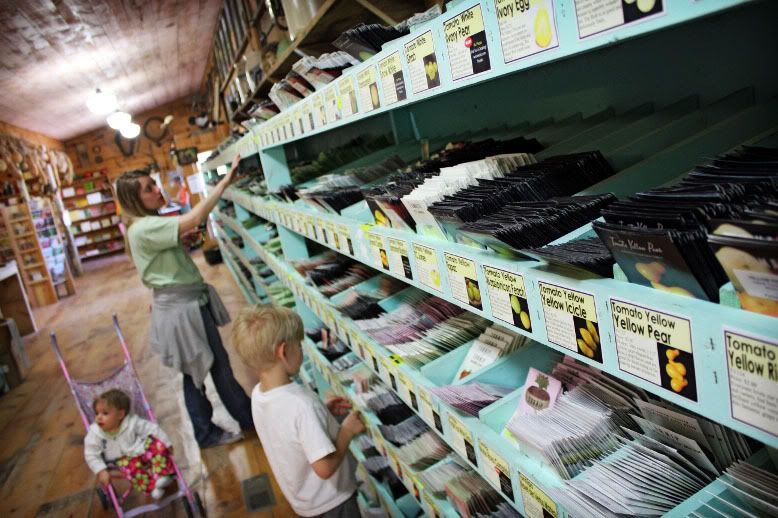
Then, came the seed buying.  This was a little overwhelming.  As you can see from the photo, there are seeds galore.  We stood before about thirty varieties of tomato seeds and finally made our decision, only to find out moments later that we had just been looking at the overflow of the real tomato seed section that housed well over a hundred varieties.

At the end of the day, we had purchased a blackberry bush, a raspberry bush, a bag of Yukon Gold potato seeds, about 25 strawberry plants, and lots o' seeds including tomatoes, cucumbers, yellow squash, bell peppers, jalapeno peppers, carrots, 3 varieties of lettuce, sugar snap peas, green beans, and a lot more that I can't think of at the moment.

It was a lot of fun and I was very impressed with what all they had built out there at Baker's Creek.  It's a neat little village that was well worth the drive.

Once again, I have made a little video using time-lapse photography for your viewing pleasure.  Check it out at this YouTube link.

Back to Eden (part two)


The second part of our gardening adventure was to put down the covering. We chose to use un-screened wood chips from Springfield Recycling Center. They were $5 per yard which equates to $15 a truckload. They also have screened wood chips which gets out all the big chunks and leaves much smaller wood chips that will break down and compost much sooner. They run $12 a yard. We decided that it was so early in the season that the larger chips would have time to break down before next year and we were afraid that our covering would break down too soon if we used the screened. We'll see how our decision turned out next spring.

In case you don't know what I'm talking about, the covering is what protects the garden and the topsoil underneath. It acts as a fairly decent weed barrier, too. How it protects the garden is pretty simple. Have you ever moved a pile of leaves or even a pile of construction scraps or a pile of virtually anything that has sat undisturbed for a few weeks. You'll notice that when you do, it's always moist underneath. The dirt is always dark and rich in appearance. The reason for this is that it was protected from the crazy environment.

Think of the wood chips to the garden just as our skin is to our body. Our skin protects us. If not for our skin, our bodies would dry up and die. So our gardens go. If they are exposed to the air, they will dry up and the top soil will erode away with the wind and wash away when it rains.

However, if you cover your garden with wood chips, the wood chips retain moisture for the dry periods, keeping your soil moist and rich, while also diverting excess water away when it rains. And, every time it rains it composts and breaks down those wood chips a little bit. And all that organic material acts like a compost tea with all the nutrient-rich tea flowing down into your garden. Your plants will thrive on it. Also, it keeps your soil from becoming compacted. The wood chips evenly spread out your weight and keep the ground from becoming compacted and unworkable. And the plants that grow in it will keep it nice and aerated.

It's been a couple weeks now since we put the covering on. Sorry for the belated posting of the video. I actually put the video together the next evening, but have been preoccupied with other projects. But, here it is. And now all we do is wait until it's time to start planting!

Back to Eden


Jodi and I recently watched a documentary online called Back to Eden. They have the documentary available for viewing directly from their website. In short, they convincingly show how to garden in a more natural, less toilsome way without the need to till, water, or struggle against dug in weeds.

Yes, it does sound too good to be true. But, feel free to watch the video yourself for all the details on why this is NOT too good to be true.

We're thoroughly convinced and have already begun the process to build our new garden using the methods that the documentary demonstrates. We'll be documenting our progress success throughout this season with some cool videos, photos, and blogs. Come back here to this blog for updates on our garden. To start things out, we've already created a cool time-lapse photography video for your viewing pleasure.

This video shows us going through step one, which is to wet three layers of newspaper and layout over the desired garden plot. It's important to overlap all the connecting edges since this will be necessary to suffocate out all the growth underneath it. This newspaper will itself break down and compose the first season, but not before it's killed everything growing under it. Once the newspaper was down, we placed roughly three to four inches of composted horse manure. This stuff was great. It was already composted so it was pretty much unrecognizable from just regular dirt. I got it from a local horse ranch for $20 a truckload. Two truckloads was enough to cover our huge garden plot which measures 22' x 41'.

We all were able to pitch in and knock it out over the course of a few days. It made for a fun video and I look forward to making a lot more. We've already begun the second step, the covering, and will have it completed soon.

CFL Bulbs Don't Come In Green


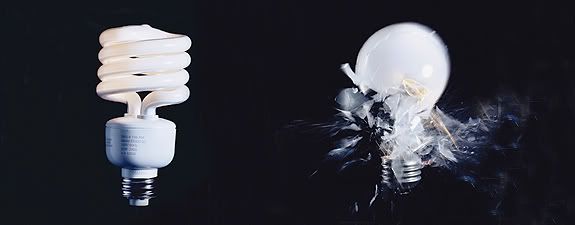
I've blogged already about how I don't like compact fluorescent light bulbs (CFL's). In the blog I questioned whether the bulbs were as "green" as they were being made out to be. I feel like my arguments at the time were pretty good, but I was missing a huge component in my case against the little pig-tailed bulbs. Until now...

Earlier this week, I spotted a headline in the News-Leader that read, "Broken fluorescent bulb cleanup requires caution". It was a 'Dear Heloise' column. If you are not familiar with who Heloise is, then you are probably unfamiliar with reading the newspaper. Heloise, according to her website www.Heloise.com, is America's premier hintologist whose columns appear in over 500 newspapers in both the United States and internationally. I wasn't aware of that before finding her website, so stop making fun of me. I was also previously unaware of the science of hintology.

Bear in mind, that it was my opinion before having read this article that CFL bulbs were worse for the environment than their more traditional incandescent counterparts. But this article really drove the nails into the CFL coffin for me. It reads as follows:
If a compact fluorescent lamp or bulb accidentally breaks, what do you do? The glass is very delicate and can shatter easily if dropped or even handled roughly when being removed from the socket. The bulbs contains a small amount of powdered mercury, so caution is needed for cleanup.
Follow these cleanup guidelines:
    Open a window for ventilation for at least 15 minutes before starting cleanup.
    Do not handle the pieces with bare hands; wear protective disposable gloves.
    Place the pieces in a plastic bag and then into another one, and use duct tape to pick up the tiny fragments.
    Wipe the area clean with damp paper towels, and place the towels in the bag, too.
    If the area where the bulb broke is carpeted, you can vacuum the carpet, but you must immediately remove the vacuum bag (or empty and wipe the canister) and put the vacuum bag in with this other bulb trash. Do not vacuum hard floor surfaces.
    Check with your trash company or call your recycling center for specific disposal directions. As a general rule, fluorescent bulbs can be put in the trash for pickup or taken to the dump if your state and local regulations allow. Or, check for a recycling center near you.
Let's continue to help the environment and go green!


So, let's condense and review, shall we? A broken CFL bulb is so toxic that we must go to some extreme cleanup measures in order to protect ourselves. A single broken bulb will add to the landfill a pair of disposable gloves, two plastic bags, some duct tape, some paper towels, and possibly a vacuum bag not to mention the mercury that you "cleaned" up. Also, if you must open a window for ventilation for 15 minutes, how much more energy are you using to reheat or recool your home? Also, the CFL bulb is much more complicated than the simple incandescent bulb and uses considerably more energy to produce. Furthermore, the CFL bulbs are not made in America. Patriotism aside, the CFL bulbs require much more energy to be shipped here compared to the American made incandescent bulb.

Make no mistake, CFL bulbs are in no way more green than incandescent bulbs. Rather, their huge Sasquatch carbon footprint and their toxicity make for a very ugly weapon to the environment. The use of CFL bubls remind me of the people who preach to recycle but are so eager to recycle, in fact, that they never reuse anything. The motto goes: Reduce, Reuse, Recycle. Which means we must first focus on the former and only use the latter as a last resort.

The CFL bulbs claim to use less energy, which may be true but the cost of the energy they use before they are ever installed in your home coupled with the cost of their environmentally toxic impact negate any energy savings they may offer during usage.

Green or Mean?


The U.S. is going green and I have mixed feelings about it. In recent years, I've heard so much about "green" this and "green" that and I can't help but wonder what all the agendas are packed away behind these movements. Of course, I know that reducing energy consumption is a good thing, so don't jump to conclusions yet about me. I simply have a habit of reading between the lines because I've found that the lines are usually packed with interesting information between them almost in every cause.

Take Al Gore's hypocrisy for example. I won't get into all the details since many of you already know about this controversy, so I'll keep it brief. He's become some poster boy for "going green" but owns large stocks in an oil company that has been known to drill in ecologically sensitive areas. He isn't signed up for the renewable energy usage programs in any one of his three homes despite those programs being readily available by the utility companies in all three areas. And his homes total over 18,000 square feet and we all know that there's no way that this amount of space can be energy efficient in any form. USA Today reported on these facts among many others supporting the belief that he doesn't practice what he preaches. I wouldn't come down so hard on him, but he talks about our energy usage as if the sky is falling. He uses such phrases as "cataclysmic catastrophe", "ticking time bomb", and "uncontrollable tailspin."

No, Al Gore's rhetoric isn't new to anyone and to me it just seems like he jumped on an obvious bandwagon to promote himself and to make some easy money. So, then why the blog topic, you ask? And I'm glad you did. It's Walmart. A couple weeks ago, Jodi went to Walmart to pick up some things. Among the list was light bulbs. But, when she got to the light bulb aisle she was shocked. No, she wasn't electrocuted. She found empty shelves where the incandescent light bulbs used to be. The only light bulbs left available for purchase were CFLs. She called me and we briefly discussed it and we decided that she should just not purchase any bulbs and that we'd get them at a later date.

This last week, I found that another Walmart also was missing the incandescents. This confirmed what we thought to be the case which is that Walmart has removed incandescent light bulbs from their store shelves. But Why? Well, I did some research and found that two years ago at the end of 2006 Walmart announced that they were setting a goal to sell 100 million CFL bulbs a year starting in 2007. This made headlines just as it was designed to do. Walmart wants to also jump on the bandwagon with ol' Al and get their name associated with trying to help reduce energy consumption as well as appear to be trying to save their customers' money.

Walmart's move came just after Oprah touted the bulbs on her TV show and sales started to rise accordingly. Oprah apparently has a lot of little Oprah-brain-washed followers that will buy any book she talks about, love anyone she loves, and believe anything she says. I'm sure that you are picking up that I don't like Oprah. Just for the record, I also don't like Barack Obama. (GASP!) Call me what you will, I can take it. I never have liked Oprah. She doesn't really listen to anyone, she just jumps in to ask questions, but doesn't care at all about the answers. She leads people down a religious path in which there is nothing to back her views other than her own disorganized and contradictory statements. And she knows that she has this influence on people and rather than humbly using it for good she uses it for her own gain. I really don't like her. Her endorsement of the CFL bulbs alone make me want to go stock pile incandescents and start searching out CFLs in use and replacing them with incandescents completely undetected like a ninja. Mmm. "Incandescent Ninja" I LIKE that.

I couldn't find anything on the Internet that was discussing Walmart's announcement that they were removing incandescents from their shelves. I only found articles talking about stores doing it in the UK. This leads me to believe that Walmart didn't announce it. Why wouldn't they announce it? In 2007, Walmart reportedly hit their goal of 100 million light bulbs sold in early October. But, maybe all those people who purchased these bulbs last year from all the hype on the pros realized all the cons as they were put to use. I fell into that category. If you've ever used these bulbs, you probably do, too.

"Did that new CFL bulb on the porch burn out already?!", I asked as I was walking towards the front door. I got there and looked through the window directly at the bulb and saw that it was indeed on, but I hadn't been able to tell from just a few feet away. "It's on, but where's the light?" Sound familiar? The manufacturers of these bulbs whose packages claim that they are the equivalent of a 100-watt incandescent clearly don't fully comprehend the definition of the word "equivalent". That's like saying that just because Fat Albert can walk a mile eventually and Carl Lewis can run a mile in under 6 minutes that they must be equal. What's next? Energy efficient garbage disposals? Flip the switch, come back in three or four minutes when the blades have picked up some momentum and then start inserting your unwanted food particles one particle at a time because a few too many uneaten peas at once can stop the rotation of the blades. We bought a total of 12 of these CFL bulbs and are down to 3 or 4 of them. Because they've burnt out. It seems to me that their lifespan has been seriously exaggerated. I highly doubt that I've saved enough from their so-called efficiency to even offset the increased cost that I paid for them. Furthermore, we limited their usage to certain areas because of the nature of their dimness. Sure, they eventually get to be as bright as incandescents after a long while, but what good does that do for a closet light? When you open the closet to get something you turn the light on. You find the item in the small room with the aid of the light and then you turn the light off. CFL's won't help you find the item you're looking for unless you have the foresight or time to turn the light on minutes before you intend to actually look for the item. But, by then you've used all that extra electricity and probably used more energy than you would have otherwise. This argument also kept us from using them in bedrooms for the same reason. The kitchen wasn't a very good place for them since you need all the light you can get in there. The bathrooms weren't an ideal CFL bulb location since it's mostly boys in the house and you don't want boys to pee in the dark. Trust me on that one. As a matter of fact, when it came down to it, there were only two places in the house that we gave in and used the CFL bulbs: the front porch and the basement. And, we could only get away with using them in those areas because we tend to leave those lights on all the time.

Sorry, CFLs, but you suck. And now, so does Walmart for putting such a huge effort towards the sale of these little useless bulbs culminating in a removal of any choice for the consumer. What I find most interesting in all my research is that these bulbs contain mercury. You are not supposed to throw them in the trash because they can pollute the soil and eventually the groundwater, lakes, and streams. The consumer is supposed to recycle them, but there's no recycling centers that take them. Currently, only IKEA will take them from customers to recycle them. Ironically, Walmart has thus far refused to set up any sort of recycling avenues for their customers. And this is doubly ironic since Walmart's recent lofty goal and push for the sale of these bulbs has pushed them into the number one seller of CFL bulbs in the Unites States. I guess that energy conservation is more important to Walmart than environmental preservation. This is probably true because an incoming dollar amount can be affixed to the former while an obvious expense is attached to the latter. Without easy accessibility to a recycling method for these bulbs, you can count on the fact that consumers will put these bulbs in the trash.

Walmart probably doesn't want to implement a recycling method for similar reasons as other companies. There is a high risk for mercury exposure in dealing with these discarded bulbs. First, how do you keep them from breaking? Because, once they're broken the exposure is imminent. To recycle these would require a quarantined area, packing them in something similar to egg crates and having the handlers wear those orange jumpsuits with the gas masks that we so often see in movies. It's no wonder why Walmart hasn't set up a way to recycle them. But, then why do they keep pushing them to be sold?

I am obviously questioning the bulb's green-ness. What do you think? Do you use them? Do you like them? Do you think that the aliens invented them? Let me know.

So, it's W's fault.


Months ago, Jodi and I were having a lot of frustration with our cell phones. The cause of this frustration: they couldn't agree on what time it was. What's more is that neither could a lot of other clocks we have around the house. We were baffled and confused and still unsure as to what time it was even after calling Time & Temperature. The problem eventually worked itself out and we forgot about all the problems it caused until yesterday.

Yesterday morning was looked forward to by both Jodi and me for a week at least. Most Sunday mornings we have to wake up before 7:00 and start getting ready for church as quietly as possible so that we don't wake up the boys. We get ready and then Aunt Ginger graciously shows up to take over with the boys so that we can go to worship practice at 8:30. We practice until 10:00 when church starts and we lead worship until about 11:00. So, we're pretty busy from the moment we wake up at 6:45. Yesterday was to be different, though. Our team switched with the Saturday night team for the weekend, so we played Saturday night and were able to get a chance to sleep in on Sunday for once.

We didn't even set an alarm since we knew we'd wake up with plenty of time. Which we did. But, here's where our morning could have been a lot better. Jodi woke and checked her cell phone for the time which read 7:35. So, she was relieved to have about another hour to sleep and enjoy the morning. But George W. Bush came in our bedroom and stole that hour from us. Okay, he didn't come in our bedroom but his influence did. My phone read 8:35. My phone is set to be automatically updated by the cell towers. So, if I change time zones (like when we went to Michigan) my phone automatically changes the time for me. My phone tells me what time the network says it is. Jodi's phone, on the other hand, is not set up in that way. Like all cell phones, it has internal software. The software was programmed years ago to allow for Daylight Savings Time and had the exact dates that these changes occurred on figured into the equation. And that's where we point a finger at the Pres.

George signed into law an energy bill in 2005 that included a measure to extend Daylight Savings Time starting in 2007. DST would start 3 weeks earlier and end 1 week later than normal. The pros to this change included the savings of 100,000 barrels of oil daily somehow, people would turn their interior and exterior lights on later in the day using less electricity, people would have an extra hour of daylight for activities, theme parks could run later, and part-time farmers would have more time after work to work their crops. The cons included children having to wait for the bus in pitch dark, the airline industry claimed millions of dollars lost to adjust schedules, and many electronic devices automatically adjust to DST on what will no longer be the correct dates including VCR's, computers, some microwaves, and apparently Jodi's cell phone.

Her cell phone will show the incorrect time all this week and will finally be back on track next Sunday at 2:00 am. I think that we tried to fix the problem last spring, but her cell phone's software doesn't have a way to fix the problem.

So, what do you think about Daylight Savings Time? Do you like it? Do you hate it? Do you have a better solution to utilizing all of God's given daylight?

Twitter Delicious Facebook Digg Stumbleupon Favorites More